
Business account: keep business and private money separate
A business account helps small entrepreneurs separate revenue, costs, private withdrawal and reserves with less bookkeeping noise.
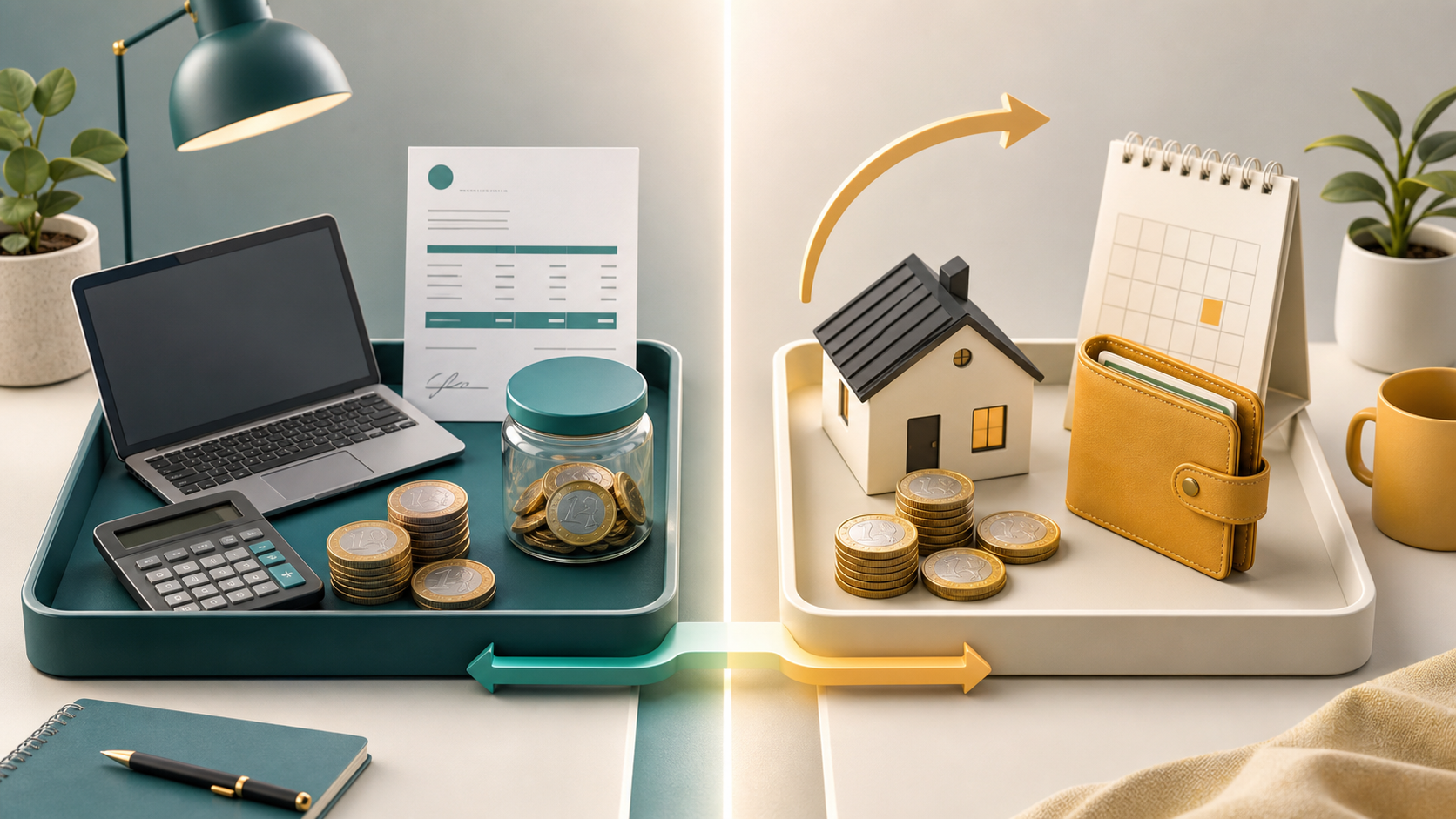
Business account as a boundary, not just an IBAN
A business account is not only an extra IBAN for a small entrepreneur. It is a visible boundary between company money and home money. Without a business account, a paid invoice can quickly feel like spendable income, while that same amount still has to cover costs, VAT, income tax, software, insurance, buffer and private withdrawals.
KVK explains that a business account is not legally required for a sole proprietorship, partnership or similar structure, but is often practical. Banks can also restrict business use of a private account in their own conditions. So the practical question is not only whether it is allowed. The better question is whether your bookkeeping stays clear when everything flows together.
This article is general planning, not tax advice. The point is cashflow discipline. A business account helps keep revenue, costs, reserves and private withdrawals visible. That prevents you from steering on bank balance instead of real available room.
Why mixed money gets messy fast
Mixed money starts innocently. A client pays into your private account, you buy software with your private card, groceries are paid from the business card and you plan to correct it later. One month later you are reconstructing which payment belonged to which task. That costs time and weakens the administration.
The Dutch Tax Administration lists bank statements, received invoices, copies of sent invoices, contracts and financial notes as records that belong in business administration. If business and private transactions sit in one stream, every bookkeeping round asks you to explain whether a payment was business, private, mixed or reimbursed.
A separate account reduces that noise. Not because the account magically does bookkeeping, but because the default is clear: business income arrives there, business costs leave from there and a private withdrawal is a deliberate transfer. Exceptions become visible.
A private withdrawal is not a business expense
For a sole proprietor, private withdrawal is normal. You need to live from the business. But a private withdrawal is not the same as salary in employment and not the same as a business expense. The Dutch Tax Administration explains that private withdrawals are paid from business assets but cannot be deducted from profit because they are not business expenses.
That distinction is exactly why a separate account helps. If you transfer a fixed private withdrawal each week or month, the amount is clearly a transfer to home. You do not need to guess whether groceries, rent, clothes or holidays were accidentally paid by the business.
Make the private withdrawal predictable. Choose a monthly base amount and a quarterly review. In strong months, extra money stays in the business until costs, tax moments and quieter weeks have been checked. In weaker months, the routine prevents random withdrawals from the business account.
Private deposits are not revenue either
Money can also move the other way. You may add private money to the business because a client pays late, equipment is needed or the first months are uneven. The Dutch Tax Administration says such a private deposit is not business profit because it is not business income. It can therefore be kept outside the fiscal profit calculation.
A business account makes that pattern easier to read. A private deposit becomes a recognisable transfer from home, not a vague plus among client payments. That helps later when you want to understand profit, liquidity and real revenue.
Write down why each private deposit was needed. Was it a timing gap caused by late payment? Was it start-up capital? Was it a correction after too much private withdrawal earlier? That information shows whether the business is structurally too tight or only needed timing support.
Build at least four money buckets
The account is the beginning, not the whole system. Inside business money, you need at least four buckets: received revenue, running business costs, tax reserves and free business room. These can be separate accounts, jars, bookkeeping categories or a clear plan in FlowyZ.
The earlier article about freelancer tax reserve goes deeper into tax reserving. The short lesson here is this: do not let VAT and income tax behave as if they are private spending money. A business account should show which money already has a job.
Free business room only matters after the other buckets are updated. First known costs, then tax reserve, then buffer for quiet weeks, and only then extra private withdrawal. That order makes a good month less misleading.
Choose a withdrawal rhythm that fits cashflow
A separate account without a withdrawal rhythm solves little. If you move money to private life on random days, the month remains noisy. Pick a rhythm: the first working day of the month, after paid invoices, or twice a month if income is uneven.
The rhythm must fit the real business. A consultant with monthly retainer invoices can often plan a fixed private withdrawal. A photographer, builder or designer with project payments may need a base withdrawal and a separate quarterly decision.
Use FlowyZ before transferring. Is software, insurance, VAT or a quiet week still coming later this month? Then a higher private withdrawal may be possible on paper but poor timing in practice. The business account gives the boundary; cashflow planning gives the moment.
Pay business costs from the business account
The simplest rule is also the most valuable: pay business costs from the company account. Software, accountant, business insurance, equipment, hosting, business phone, travel costs and professional learning should not be scattered across private cards, credit cards and payment apps.
KVK advises entrepreneurs to set up administration and bookkeeping properly and learn about taxes. A business account makes that less labour intensive. The bookkeeper sees what happened faster, receipts are easier to match and fewer private transactions need filtering.
If you still use a private card for a business purchase, record it immediately as an advance or reimbursement to yourself. Do not wait until the quarter has passed. The faster the correction is visible, the less the business account becomes a memory puzzle.
Keep private spending out of the business account
The other side matters just as much. Avoid paying private expenses from the business account. Family lunch, rent, clothes, holidays, sport, streaming and groceries belong to private money, even when the business account has enough balance.
That requires discipline, especially when the business account looks healthier than the private account. But that higher balance is usually a mix of future costs, reserves, VAT, profit and buffer. Paying private expenses from it makes business obligations look smaller than they are.
Create a practical error rule. If you accidentally pay privately from business, mark it that same day as a private withdrawal. If it happens often, your private withdrawal is probably too low, too irregular or not aligned with real household costs.
Store records as if future-you must explain them
The Dutch Tax Administration says basic administration records generally need to be kept for seven years, and records for immovable property for ten years. That sounds administrative, but it directly affects the business account. Bank statements, invoices and contracts must remain checkable later.
A business account makes storage easier because the bank flow is already separated. Years later, you do not need to search through birthdays, supermarkets and private subscriptions to find a business payment. The administration stays smaller and easier to explain.
Update monthly. Download or sync bank transactions, upload receipts, check open invoices and label private withdrawals and private deposits. A small monthly routine prevents you from reconstructing the previous year in March.
Do not make the business account too complicated
Some entrepreneurs immediately create five accounts, complex jars and rules they will not keep. That is not needed. A business account should create clarity, not another layer of work. Start with one main business account and a simple way to show tax, costs and buffer.
You can expand later. If VAT often surprises you, open a separate reserve account or create a clear jar. If equipment and software create annual spikes, build a cost reserve. If private withdrawal keeps causing friction, recalculate the base withdrawal.
The best business account is not the one with the most features. It is the one that makes your behaviour calmer. Money arrives in the right place, leaves through the right route and receives a job before you spend it.
Discuss the boundary at home
For many small entrepreneurs, separating business and private money is also a household agreement. Partners, children or housemates may only see that money has arrived. Without context, a full business account can feel like household room while the business still has obligations to pay.
Explain the order: revenue in, costs aside, tax aside, buffer aside, private withdrawal to the household account. Only then does the household decide on private spending. That conversation removes tension between business balance and spendable income.
FlowyZ can help because business timing and private room can be viewed side by side. A business account separates the streams; the plan shows when money is truly free for home.
From balance to steering information
The account is not the goal. The goal is that your bank balance becomes steering information. You see faster which invoices are paid, which costs are coming, how much private withdrawal is realistic and which money should not be touched.
Start small. Use a business account, let clients pay there, pay business costs from it and make private withdrawal a recognisable transfer. Label private deposits and private withdrawals immediately. Check each month whether the money buckets still make sense.
Then separating business and private money changes from an administrative chore into calm. Not because entrepreneurship becomes predictable, but because you guess less. The business account gives the boundary, and FlowyZ helps you see the timing.