
Car costs: what ownership really costs each month
Car costs go beyond fuel and finance payments. Make depreciation, maintenance, insurance, tax, repairs, parking and replacement visible.
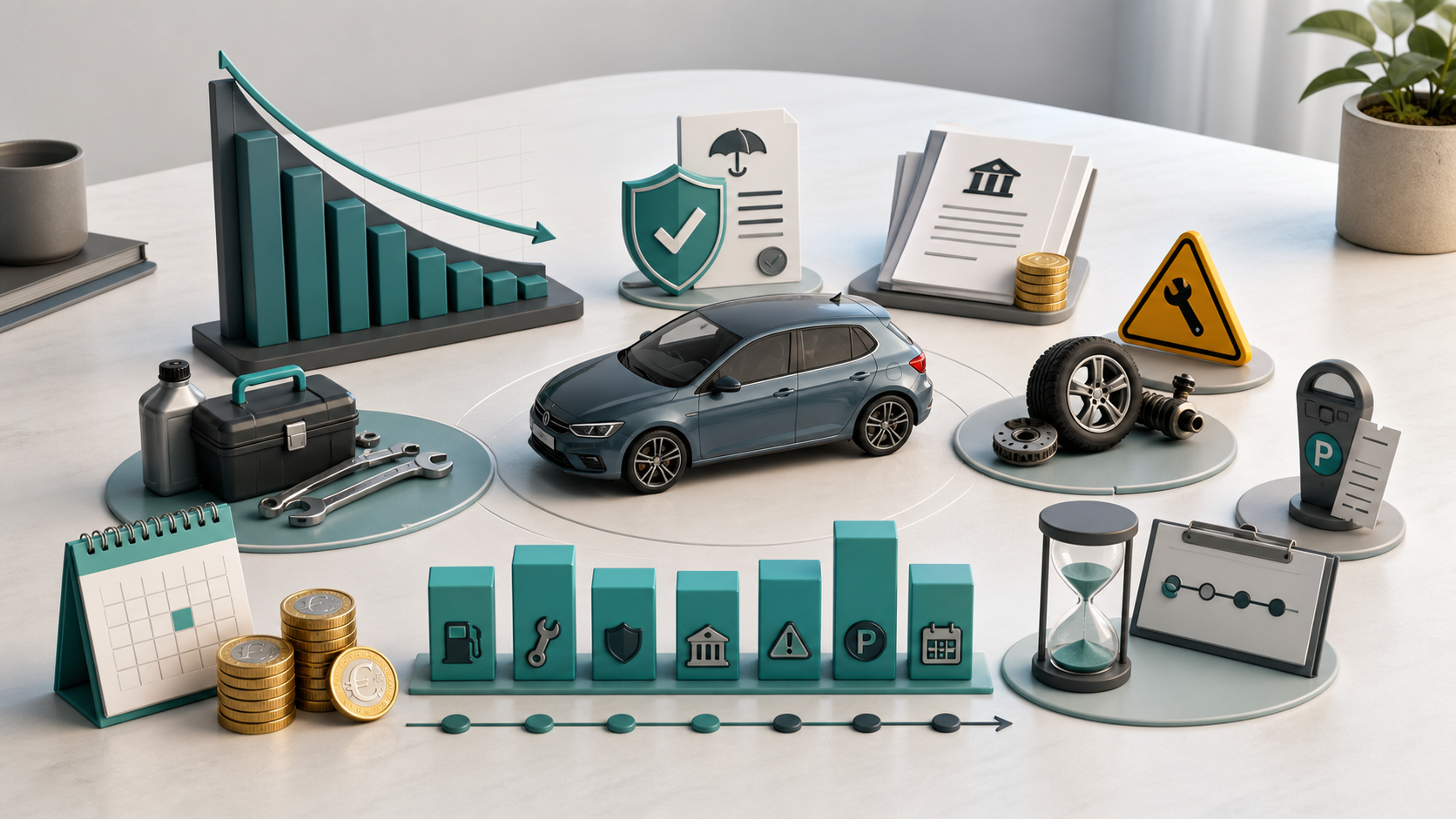
Car costs start before the fuel pump
Car costs often look manageable when you only count fuel, charging or a finance payment. Those payments are visible, so they get attention. Real ownership is wider. A car loses value, needs maintenance, requires insurance, attracts tax, wears tyres, takes parking space and eventually has to be replaced.
Nibud lists car costs such as fuel, maintenance, road tax, insurance and loss of value. ANWB also calculates car costs per month or per kilometre and separates fixed and variable items. The practical lesson is simple: car costs are not random receipts. They are the cost of owning and using a vehicle over time.
That matters for households and freelancers because a car can feel necessary. Work, school, care duties, client visits, tools and children can all make mobility valuable. Necessary does not automatically mean affordable in every month. Car costs deserve the same cashflow attention as rent, energy, healthcare, tax and debt payments.
Split car costs into three layers
Start with three layers. The first layer is ownership: depreciation, insurance, road tax, roadside assistance, parking permits and finance interest. These car costs exist even if the car sits still for a week. They are the price of having the car available.
The second layer is usage: fuel or electricity, parking while travelling, tolls, car washing, fluids and extra kilometres. These car costs move with behaviour. A freelancer who suddenly visits more clients will feel this layer faster than a household with stable routes.
The third layer is wear and future replacement: servicing, inspection, tyres, repairs, insurance excess after damage and the next car. These car costs do not arrive neatly each month, but every month of ownership helps create them. If you ignore this layer, the car looks cheaper than it really is.
Depreciation is money leaving quietly
Depreciation does not feel like a bill. Nobody sends a monthly invoice for value loss. Still, it can be one of the largest car costs. If you buy a car for 18,000 euros and later expect to sell it for 10,000 euros, 8,000 euros of value disappears during ownership. That money may not leave your bank account this month, but it is real.
ANWB has separate guidance and tools for depreciation and total car costs. That is useful because value loss differs by car, age, mileage, fuel type and market conditions. A cheap purchase can become expensive if repairs and resale value disappoint. A more expensive car can sometimes be more predictable, but only when the full picture works.
Put depreciation into FlowyZ as a monthly planning line. You are not paying that amount to a supplier every month. You are making the future replacement honest. Without depreciation, free room can look larger than it is. With depreciation, you see which car your current and future month can carry.
Maintenance and repairs are different car costs
Maintenance is expected. Think of service intervals, inspections, oil, filters, brakes, tyres, air conditioning, wipers and normal wear. Repairs are less predictable: battery, alternator, clutch, electronics, damage, filters or a warning light just outside warranty. Both car costs belong in the plan, but they need different thinking.
Use maintenance history as the starting point. What did you pay last year? Which service is next? When may tyres need replacement? Which mileage point is approaching? ANWB notes that maintenance can differ strongly by brand, model and service interval. Do not ask only what the car costs to buy. Ask what normal ownership costs.
For repairs, a realistic range is better than zero. Older cars can look cheap for months and then ask for a large payment. That does not make older cars wrong. It means car costs for an older vehicle are less smooth. FlowyZ helps by making the larger moments visible before they collide with the rest of the month.
Insurance and tax move with the car
Car insurance is not a fixed law of nature. Premiums can depend on cover level, claim-free years, driver profile, region, value, age and excess. Road tax depends on weight, fuel type and location rules. These car costs can change when you choose a different car, move house or adjust cover.
Look beyond the lowest premium. A higher excess can lower the monthly amount but make damage more painful. Comprehensive cover can make sense for a young or financed car and be excessive for an older car with limited value. Basic liability can feel cheap, but damage to your own car remains your problem.
Make an insurance check part of the car review without turning it into a separate project. Does the cover still fit the value, usage and available buffer? Freelancers have one more question: business use, goods transport or client visits may require different terms. Check that before damage turns into an argument.
Financing can hide the full car costs
A loan or dealer finance can make a car reachable, but the monthly payment is not the same as total car costs. Interest, term, balloon payment, required maintenance, insurance conditions and possible negative equity shape the real pressure. A low monthly payment can feel comfortable while the car locks in room for years.
Put financing next to ownership and usage. The finance payment is a cashflow item. Depreciation still exists. Maintenance still exists. Insurance and tax still exist. If you only plan the loan, you miss a large part of the car costs.
FlowyZ already has a separate article about lease affordability planning. This car costs check is broader. Even when you buy with savings or drive a used car, ownership costs still matter. The question is not only whether you can pay. The better question is whether the month stays healthy after everything is included.
Parking and small items deserve a line
Parking is often the forgotten line. At home there may be a permit. Around work or clients, paid parking can become normal. In cities, visitor parking, charging spots, garages and fines appear faster than expected. For households with two cars, parking alone can make the second car more expensive than planned.
Small car costs look harmless one by one: washing, fluids, accessories, child seats, roof bars, environmental stickers, tolls, roadside assistance, charging cards, cables or winter wheels. Together they create the noise that makes a month slightly tighter. You do not need a separate line for every tiny item, but a monthly average is useful.
For freelancers, business driving needs extra care. Client parking, more mileage, carrying equipment and reliability expectations can make the car more expensive than private use. If clients reimburse travel, also plan when that reimbursement arrives. A payment in six weeks does not help today's parking machine.
A second car or larger model needs a test
A second car can feel like the answer to work schedules, school runs or family logistics. It adds convenience, but it also adds car costs: insurance, tax, maintenance, tyres, inspection, depreciation and replacement. Even a cheap second car can be expensive if it hardly moves.
Test alternatives before buying. Could some journeys use a bicycle, shared car, public transport, remote work, carpooling, cargo bike, taxi at peak moments or short-term rental? Not because a car is always luxury, but because fixed ownership costs are heavy when usage is low. A costly occasional trip can still be cheaper than a second car that costs money all year.
The same applies to a bigger model. More space can be necessary for a family, tools or towing. But more weight can raise tax, tyres, fuel and insurance. The practical question is: how many months each year do you truly need that extra capacity, and what does it cost in all the other months?
Replacement planning without overcomplicating it
A car has an end date, even if you do not know it yet. One day repairs stop making sense, your household changes, work changes or you want more reliability. Replacement is therefore part of car costs. Not as a theory, but as a simple question: when will buying power probably be needed again?
Build three scenarios. In the first, you keep driving and accept a higher repair risk. In the second, you replace the car in two or three years. In the third, replacement comes sooner because of damage, work or family changes. For each scenario, write down the likely purchase price, sale value and monthly pressure.
This prevents the next car from becoming a shock. You can see whether the current car is cheap because it truly is cheap, or because replacement is still outside the plan. That difference makes car costs more honest.
Freelancers should separate private and business use
For freelancers, a car can be private property, work equipment and an admin topic at the same time. That makes car costs more sensitive. A van or estate car may make jobs possible, but it can also create fixed pressure in quiet months. A private car used for business kilometres needs solid records and realistic kilometre costs.
This article is not tax advice. Use the rules from the Dutch tax authority, your accountant or adviser for deductibility, VAT, private use and mileage records. The cashflow question still remains: when do insurance, maintenance, tax, fuel and repairs leave the account, and when do client payments arrive?
In FlowyZ you can keep business car costs separate from household spending. That prevents a good revenue month from looking like free private money when maintenance, tax or replacement still has to be paid. With irregular income, that separation is practical.
A simple monthly check for car costs
Create one car costs line with ten parts: depreciation, finance, insurance, road tax, fuel or electricity, maintenance, repair range, tyres, parking and replacement. Do not wait for perfect numbers. Start with estimates from bank statements, maintenance history, ANWB tools and Nibud guidance.
Then look three months ahead. Does the car still fit beside groceries, rent or mortgage, energy, healthcare, childcare, taxes and other commitments? What happens if maintenance and insurance land in the same month? What happens if a client pays late or income drops temporarily?
The answer does not have to be "sell the car". Sometimes the answer is: drive longer, drive less, adjust insurance, service earlier, change parking habits, choose a smaller model or delay replacement. Good car costs planning gives you options before stress becomes the only option.
From car ownership to calmer cashflow
Car costs become calmer when you stop treating them as isolated payments. Fuel is visible, but depreciation, maintenance, insurance, tax, repairs, parking, financing and replacement decide what ownership really costs. That total belongs in the month, not only in a panic at the garage.
Start with the car you already have. Put the known amounts in FlowyZ, add a realistic maintenance line and create a replacement scenario. Compare other cars only after that. The best choice is not automatically the cheapest purchase or the lowest monthly payment. The best choice is the car whose car costs fit your real life.