
December spending: plan gifts and birthdays without the cashflow shock
December spending gets calmer with a gift calendar, early limits, monthly saving and clear household expectations.
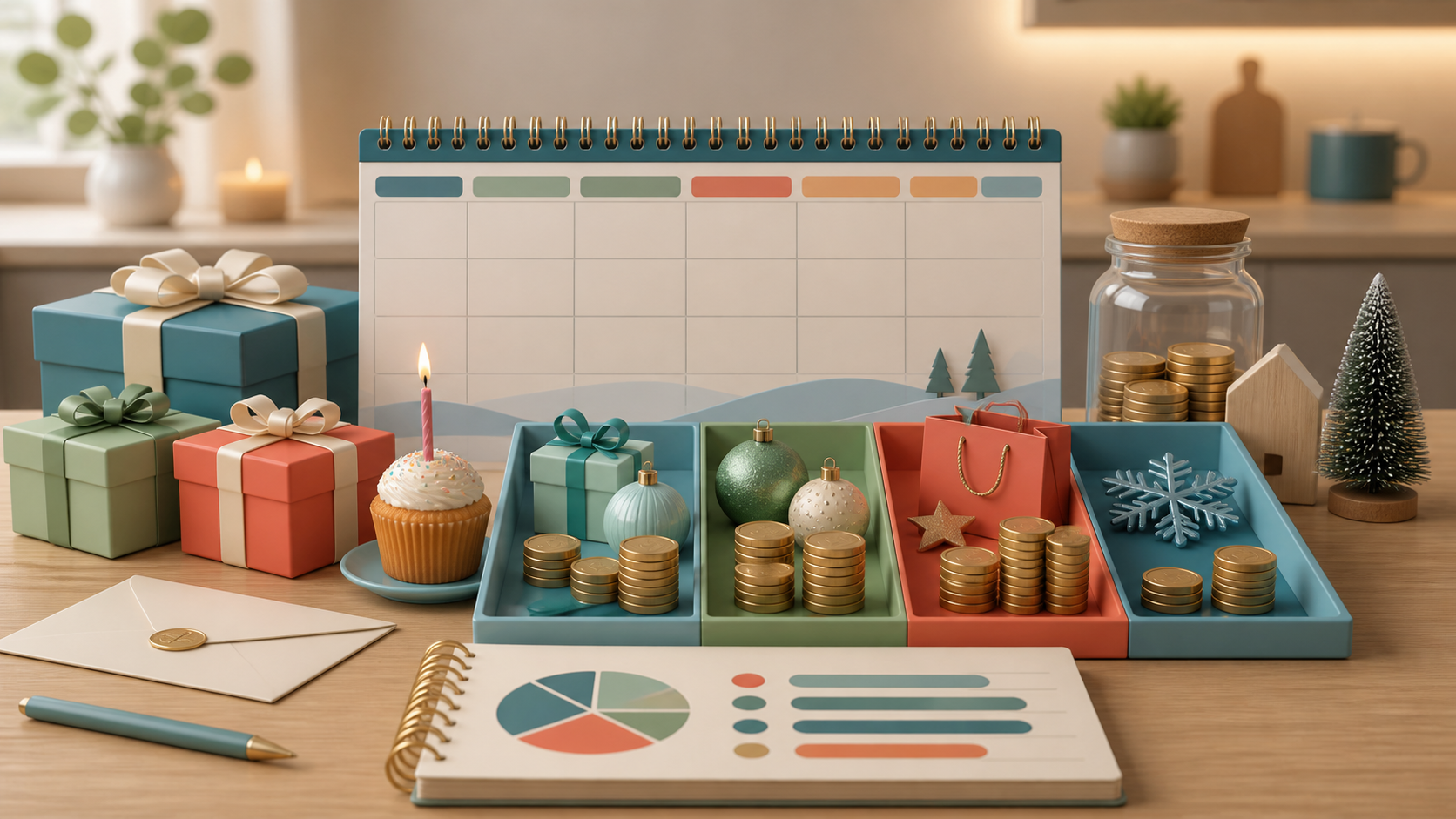
December spending is predictable, but still feels sudden
December spending rarely appears from nowhere. Birthdays are on the calendar, holidays return every year, and most households know months ahead that gifts, meals, school events or family visits are coming. Still, December spending can feel sudden because it does not behave like a normal week.
Nibud's guidance on planning and budgeting is built around making income and expenses visible before decisions are made. That is useful for December spending too: not because every gift needs to feel clinical, but because generosity is easier when January does not start with stress.
This article is for households that want to give gifts without trapping their cashflow. December spending is about expectations, relationships and habits. The practical answer is not only to spend less, but to decide earlier what enough means.
Why December spending behaves differently
A normal grocery week has rhythm. You know the shop, the basic products and roughly what the range should be. December spending has less rhythm. There may be a birthday gift, a school contribution, a shared dinner, extra travel, clothes for an event and several small festive extras.
Because December spending often comes in many small lines, it slips out of sight. One gift looks reasonable. A card, wrapping, drinks, dessert and an extra taxi also look reasonable. Together they create a month that is much more expensive than expected.
So treat December spending as a temporary cashflow peak. It is not a disaster and it does not need shame. It is known pressure. Once the peak is visible, fewer choices have to be made under last-minute pressure.
Start with a gift calendar
Build a gift calendar for the whole year, with special attention to December spending. Add birthdays, children's parties, holiday gifts, end-of-year drinks, school moments and family days. The goal is not to turn family life into administration. The goal is to see how many moments ask for money.
Then give each moment a rough limit. Small, normal and special may be enough. The gift peak becomes manageable when you know not only who receives something, but also what boundary belongs to that moment.
Use FlowyZ or another planner to move those moments forward instead of letting them land only in the payment month. A November birthday and holiday gifts then do not unexpectedly compete with rent, insurance, food or transport. Connect this to your ordinary household budget planning, so gifts are not managed outside the month.
Agree limits before anyone is in the shop
A lot of December spending grows because nobody wants to start the conversation. Nobody wants to sound cheap. Nobody wants to be the first person to say that the old habit no longer fits. So the habit wins, especially in families where gift values have slowly crept up.
A limit works better when it is said early and plainly. For example: this year there is a fixed adult gift limit, children receive gifts within a shared amount, or the family draws names instead of buying for everyone. December spending then falls through agreement, not through an emergency brake.
Make the limit concrete enough to avoid confusion. A friendly budget is not less attention. It moves attention toward fit, timing and thoughtfulness instead of price.
Gifts do not need to get bigger every year
One risk in December spending is that last year becomes the new minimum. An expensive gift starts to feel normal. A larger dinner becomes standard. An extra activity becomes tradition, even if nobody actually decided that the household budget could carry it.
Ask what the gift is supposed to do. Should it surprise, help, create a memory, make time together possible, or simply show that you thought about someone? December spending often drops once the purpose is clearer than the price.
For households with children, steady expectations help. Children remember rituals as well as amounts. A fixed number of gifts, a wish list with priorities or a shared activity can be clearer than a growing pile.
Save monthly, without making it complicated
Nibud discusses monthly saving as a way to set money aside for goals. For December spending, that can be simple: estimate the annual gift and holiday amount, divide it by twelve and place the money somewhere it does not disappear into the daily account.
Keep the estimate practical. Add birthdays, holidays and other gift moments. Include a small margin for cards, postage, wrapping or meals. December spending does not require a perfect model. It needs a visible pot.
If the year is already halfway through, start anyway. You do not have to wait for January. Every month that reserves something reduces later pressure. Even partial preparation is better than forcing all December spending onto one pay cycle.
Put a no-list beside the wish list
A wish list is normal. A no-list is just as useful. Write down what you are not doing this year: no extra gift for distant acquaintances, no expensive secret gift exchange, no new festive outfit, no last-minute delivery surcharge, or no restaurant meal when home already works.
That no-list protects December spending from decisions created only by hurry. It is easier to decline kindly when the boundary already exists. You do not have to treat every invitation as a fresh moral test.
Discuss the no-list inside the household. Otherwise one person sets the boundary and another softens it in the shop. December spending stays calmer when everyone uses the same rules.
Watch birthdays around the holidays
Households with many birthdays in November, December or January have a double peak. This is not just a holiday issue. It is two social rhythms at once: personal attention and seasonal expectation. December spending is easily underplanned in that situation.
Put those birthdays in a separate line. Do not silently give them less care because the holidays are expensive, but do not let them compete without limits either. A separate category keeps birthday gifts from constantly draining the holiday pot.
For children, a birthday near the holidays can be sensitive. Agree not only on an amount, but also on the form. That might mean a separate birthday moment, a smaller holiday gift, or an experience later when the month is calmer.
Do not use urgency as a payment strategy
Many December spending choices happen in the final week: a quick extra gift, an extra bottle, a gift card because the first plan failed. Urgency makes price comparison, delivery choices and good judgement harder.
Create two lists early: decided and open. Decided purchases can be made when the price is good. Open choices get a maximum, so they cannot expand just because time is short. December spending then stays closer to the plan, even when not everything is fixed.
Be careful with buy-now-pay-later solutions for December spending that already exceeds the limit. They move the bill into a month where normal costs continue. A cheaper gift now is often calmer than a costly gift that makes January smaller.
Make expectations visible in FlowyZ
In FlowyZ, December spending can be treated as planned variable cost. Create a category for gifts and holidays, add known moments and spread the amount over earlier months if that fits your cashflow. You then see sooner when December is too heavy.
Use labels such as must, want and can wait. A child's birthday gift may be must. Extra decorations or a luxury dinner may be want. A larger family activity may wait. December spending becomes less vague when every item has a role.
The point is not perfect forecasting. The point is that December spending should not appear only after the card payments are done. Planning gives room to trade: buy earlier, choose smaller, invite fewer people, or move an activity.
A calm plan for this year
Step one: collect every gift moment through January. Step two: add a realistic ceiling to each moment. Step three: compare the total with the months where money is actually available. Step four: choose what to simplify before shopping starts.
Step five: say the most important boundaries out loud with family. Step six: set money aside when income arrives. Step seven: keep a small margin for forgotten details, but do not call that margin free spending. This turns seasonal gift costs into a plan instead of scattered impulses.
After one round, next year gets easier. The calendar can remain, amounts can be adjusted, and conversations about limits become more normal. December spending stays human, but less surprising.
The practical conclusion on December spending
December spending needs more than a saving tip. It touches family, children, expectations and the wish to be generous. That is why planning helps. A boundary does not make a gift cold; it prevents attention from being confused with price.
Nibud points households toward overview, budgeting and saving for goals. Apply that soberly to December spending. Put moments on the calendar, agree limits early, reserve monthly where possible and protect January from December pressure.
Then there is still room for warmth without every invitation or wish list taking over the month. December spending does not disappear, but it gets a place. For many households, that is enough to choose more calmly.