
Dollar cost averaging: useful habit or false comfort?
Dollar cost averaging can calm beginner investors, but it does not replace buffers, cost checks or a fair lump sum comparison.
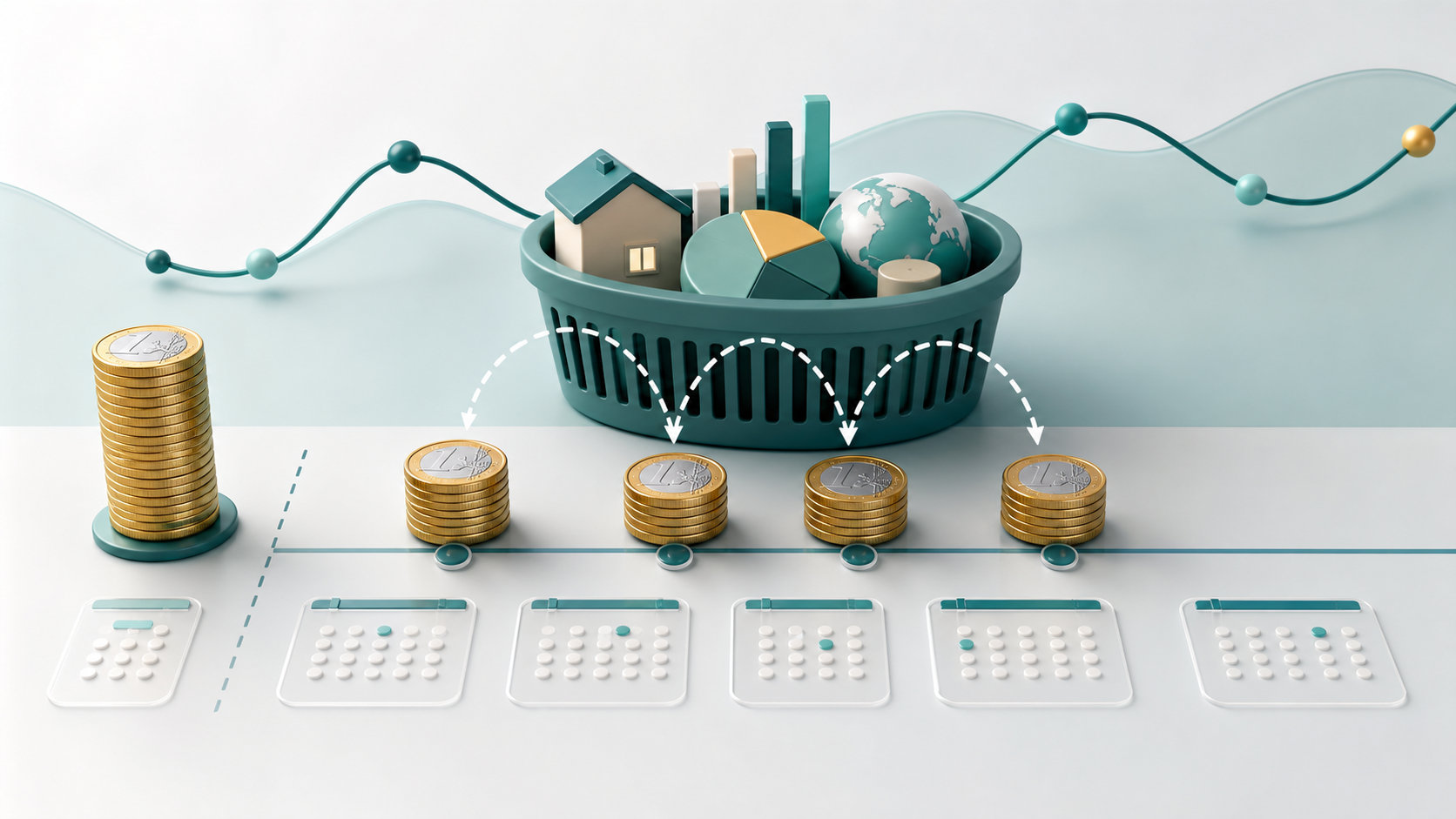
Dollar cost averaging is a rhythm, not a promise
Dollar cost averaging sounds technical, but the idea is simple. You invest the same amount at fixed moments, whether the market is higher or lower that month. Investor.gov describes it as investing in equal portions at regular intervals. For beginners, dollar cost averaging is mainly a rhythm that keeps every purchase from becoming a large timing decision.
That makes dollar cost averaging useful, but not magic. It does not automatically lower the risk of the product you buy. A risky fund remains risky. A monthly amount that is too large remains too large. And if you already have a lump sum available, spreading it over months can mean part of the money stays in cash and misses possible market gains.
This article is general education, not personal financial advice. The practical question is whether dollar cost averaging helps you invest consistently with money that can truly stay invested, or whether it gives false comfort while the household base is still weak.
Why dollar cost averaging calms beginners
The strongest case for dollar cost averaging is behavior. FINRA explains that a fixed schedule can remove some emotion from investing because you do not need to react to every market rise or fall. A beginner does not have to guess whether today is the perfect entry point. The plan says: this amount, this date, this long-term pot.
That simplicity matters. Some households delay investing because they wait for certainty. Others buy quickly when markets rise because they fear missing out. Dollar cost averaging reduces the pressure on one moment. The decision moves from market prediction to household rhythm.
That fits FlowyZ. First you see fixed costs, buffer, annual bills and goals. Then periodic investing can happen only with money that no longer has a short-term job. Investing becomes less a reaction to news and more an appointment that fits the cashflow.
The average purchase price can help
With dollar cost averaging, the same amount buys more units when the price is lower and fewer units when the price is higher. Investor.gov points out this mechanism. It can make the average purchase price over several moments lower than buying the same number of units every time.
It is still not a profit guarantee. If markets rise for a long period, early purchases were cheaper than later purchases. Dollar cost averaging can then underperform investing the available money all at once. If the market falls first, the rhythm can feel useful because not all money declines from day one.
The beginner lesson is sober: dollar cost averaging changes timing risk, but it does not remove market risk. It spreads entry points. It does not repair a poor product choice, a short time horizon or a missing emergency buffer.
Lump sum can be stronger on paper
The difficult comparison is dollar cost averaging versus lump sum investing. Lump sum means available long-term money is invested immediately. FINRA notes that holding cash longer and investing gradually often produces lower returns than lump sum investing, especially over longer periods. The reason is direct: money that is not yet invested does not fully participate when markets rise.
That does not make lump sum automatically better for every household. Expected return on paper is different from staying calm when a large amount falls soon after purchase. Some beginners sell at exactly the wrong time. For them, dollar cost averaging may be less optimal mathematically but more realistic behaviorally.
Do not choose only with a calculator. Ask whether you can see the amount fall without breaking the plan. If the answer is no, dollar cost averaging can be a behavioral bridge. If the answer is yes and the money is truly long term, lump sum deserves a fair comparison.
Cash on the sidelines has a job
Using dollar cost averaging with an existing sum means holding some cash temporarily. FINRA says that money on the sidelines needs to be managed so it remains available for future scheduled investments. That sounds dull, but it matters. Money meant for later investing should not quietly drift into holidays, furniture or monthly shortfalls.
Create two separate pots. The first is the emergency buffer and stays outside investing. The second is planned investment cash if you deliberately use dollar cost averaging for money already available. Do not mix them. Otherwise the plan looks safe while the same euros have several jobs.
FlowyZ can make that boundary visible. Put the planned investment date in the monthly view and label the remaining amount as reserved for investing. Then you can see whether dollar cost averaging is a real schedule or just an intention that disappears in an expensive month.
Costs can make the rhythm expensive
Dollar cost averaging uses multiple transactions. If a broker, fund or platform charges per purchase, many small purchases can cost more than one larger purchase. FINRA names transaction costs as a limitation of dollar cost averaging. Investor.gov also stresses that fees can reduce investment returns.
Check costs before choosing the rhythm. Are there dealing fees? Minimum orders? Currency conversion costs? Platform fees? Does dividend reinvestment create charges? Dollar cost averaging is practical only when the amount is large enough that costs do not dominate the plan.
A beginner does not need a perfect model. A simple rule helps: if monthly costs are so visible that they drive the decision, the contribution may be too small or the route too expensive. Investing less often, or choosing a different product type, may be more sensible.
Dollar cost averaging does not fix product risk
A fixed rhythm feels orderly. That is why this method can give false comfort when the underlying investment is not understood. Periodically buying something concentrated, expensive or speculative remains concentrated, expensive or speculative. The schedule does not make the content safer.
Investor.gov explains that time horizon and risk tolerance matter for asset allocation, and that diversification can reduce risk without removing every risk. That still applies. Dollar cost averaging is an entry method, not a portfolio design. It does not decide which fund, share or product fits you.
Read the earlier FlowyZ article on index funds, individual shares and diversification. This article does not repeat diversification basics, but the boundary matters: the method controls when you buy, not whether what you buy is appropriate.
When this method makes sense
Dollar cost averaging makes sense when money arrives monthly. Salary, regular business income or an automatic contribution from income creates no real lump sum decision. You invest money as it becomes available, after fixed costs, the buffer and goals are covered.
It can also make sense when a large amount feels emotionally too heavy. You can decide in advance to invest it in six or twelve equal parts. Write down why you chose that period. Without an end date, dollar cost averaging can turn into endless waiting.
A good periodic investing rule includes amount, date, product category, end date if an existing sum is involved, and a stop rule. The stop rule says when you pause: income loss, buffer below target, expensive debt or a changed goal. The rhythm remains subordinate to household reality.
When this method is false comfort
Dollar cost averaging becomes false comfort when it avoids the real question. Are you investing money needed soon? Is the buffer too small? Do you not understand the product? Are you choosing the rhythm only because volatility scares you, while you cannot really carry that volatility? Then dollar cost averaging is not the solution.
It can also be false comfort when someone uses it as disguised market timing. Saying each month that the market is too expensive and waiting one more month is not a fixed schedule. That is forecasting. Dollar cost averaging requires discipline both ways: buying when markets fall and buying when markets feel expensive.
Use a simple test: would you still invest the amount if the market jumped this month? And if the market dropped sharply? If the answer keeps depending on news, the plan is probably uncertainty with a label.
Build it into cashflow
Start with the amount that can safely leave the month. Not the amount that looks good in a calculator, but the amount that still fits when healthcare, insurance, holidays, maintenance or taxes cluster together. Dollar cost averaging works only if the contribution does not need to be reversed repeatedly.
Put automatic investing after income arrives, but after necessary reserves. Pay fixed costs, emergency buffer repair and known annual pots first. If space remains, dollar cost averaging can become a calm long-term habit. If there is no space, pausing is more rational than investing stress money.
Use FlowyZ to look three months ahead. Does the contribution still fit in an expensive month? Does the buffer stay above the line? Is there no overdraft risk just before payday? Then the rhythm is operationally realistic. The best investing plan is the one a household can actually keep.
A beginner decision frame
Use this frame before starting dollar cost averaging. One: is the money unnecessary for several years? Two: is the emergency buffer separate? Three: are expensive debts under control? Four: do you understand the costs? Five: do you understand the product well enough to sit through a decline?
Six: if a lump sum is available, have you consciously compared immediate investing with gradual investing? Seven: does the dollar cost averaging schedule have an end date? Eight: is the contribution visible in cashflow? Nine: do you know when you would pause? Ten: if your situation is complex, have you considered professional advice?
If several answers are no, the next step is not necessarily investing. It may be reading, comparing fees, building a buffer or asking for advice. Dollar cost averaging is useful when it makes a prepared plan easier to execute. It is weak when it replaces preparation.
The sober conclusion
Dollar cost averaging is a useful habit for many beginners because it simplifies behavior. It turns investing into a recurring appointment rather than a stressful judgement about the market. That is real value, especially when contributions come from monthly income.
At the same time, dollar cost averaging is not free protection. Lump sum can be financially stronger when money is already available and the horizon is long enough. Fees can add up. Cash on the sidelines can create opportunity cost. And the schedule does not change product risk, a short horizon or a weak buffer.
The best question is not whether this method is good or bad. The best question is what you use it for. If it helps long-term money get invested consistently and affordably, it is a useful habit. If it mostly packages fear, it is false comfort.