
Energy bill planning: fixed, variable and uncertain costs
An energy bill needs more than a monthly payment. Plan fixed, variable and dynamic tariffs with seasonal margin.
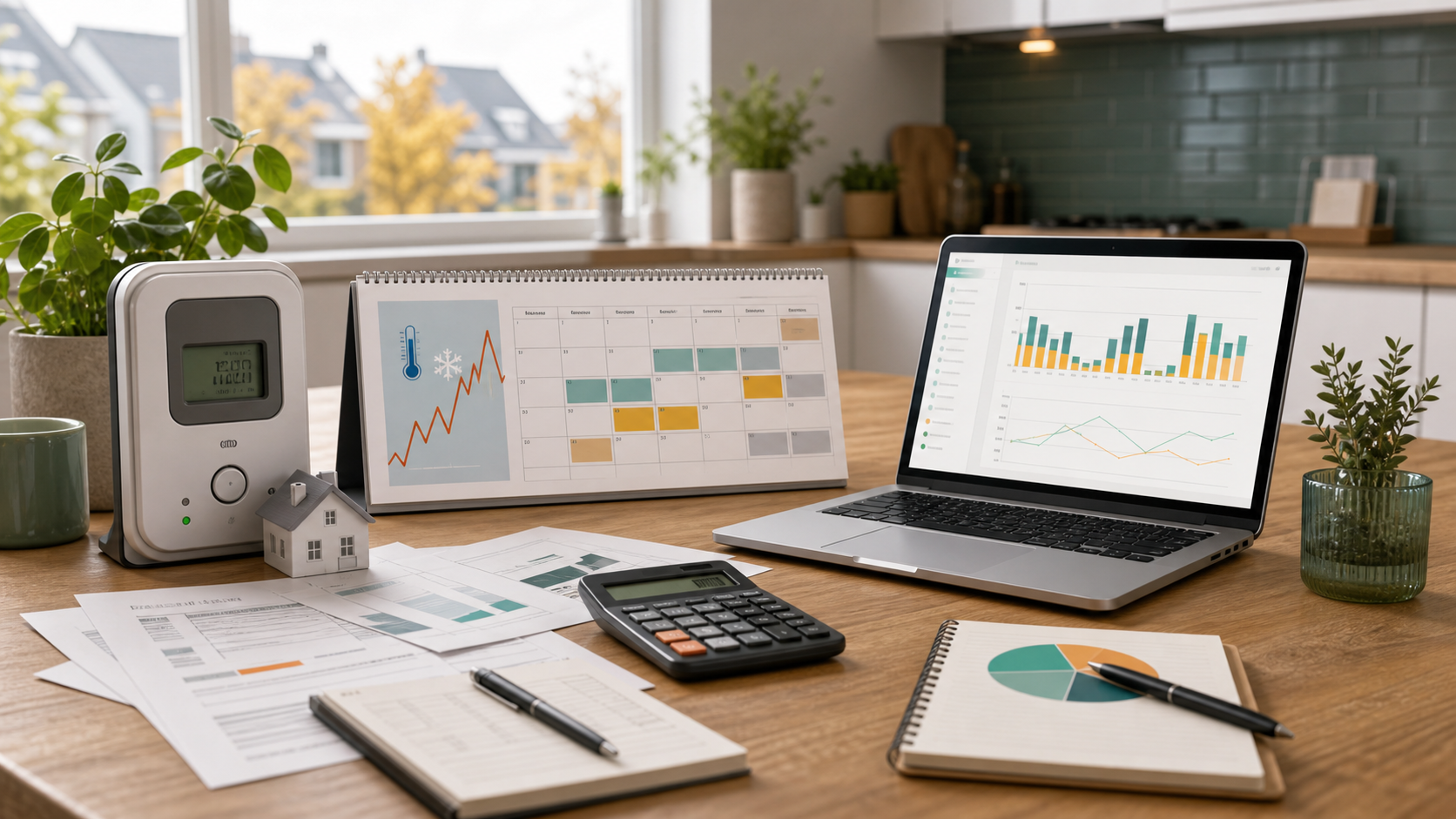
An energy bill is not a normal fixed cost. The energy bill returns every month, but the amount behind it moves with contract type, usage, season, tariffs and sometimes the monthly payment you choose yourself. That means an energy bill can look stable while the real risk only appears at the annual settlement or in a new contract period.
For households and small teams, the energy bill is therefore a planning question. Do you choose calm with a fixed tariff, flexibility with a variable tariff, or direct market movement with a dynamic contract? And how do you prevent a mild summer or a low monthly payment from making the month look too optimistic?
ACM ConsuWijzer advises consumers to compare energy offers carefully and check contract duration, tariff type, fixed supply costs, feed-in terms and conditions. Nibud explains that energy costs differ by household because of home, behavior, tariffs and usage. That combination makes the energy bill ideal for cashflow planning: you do not only want to know what you pay now, but also what may happen.
Energy bill starts with contract choice
The energy bill is shaped heavily by the contract. A fixed contract gives an agreed tariff for an agreed period. That can create calm, especially if you do not want to follow every price move. The energy bill does not become fully predictable, because usage still moves, but tariff risk is lower during the fixed period.
A variable contract works differently. The tariff can change periodically. That can help when prices fall, but it can feel uncomfortable when prices rise. A variable energy bill therefore needs more margin in the monthly plan. You should not only look at today's monthly payment, but also at what happens if the tariff is higher later.
A dynamic contract links electricity and sometimes gas more directly to market prices. That can be attractive for people who can steer usage, such as washing or charging during cheaper hours. But a dynamic energy bill can also move faster. People who do not want to plan actively can overvalue cheap hours and forget expensive moments.
The best choice is therefore not just the cheapest offer today. The best choice is the one that fits how much uncertainty your household or team can carry.
The energy bill is amount plus timing
Many people treat the energy bill as a monthly amount. The payment is collected automatically and the rest feels handled. Yet that monthly amount is often an estimate. The annual settlement compares monthly payments with actual usage and tariffs. Then you may receive money back, or you may need to pay extra.
That makes timing important. A monthly payment of 180 euros may feel comfortable, but if the real average is 230 euros, you are moving 50 euros per month into the future. After twelve months, that is 600 euros of pressure on an ordinary month. A payment that is too high can also trap money that you cannot use for other goals now.
FlowyZ helps by treating the energy bill not only as a debit, but as risk over time. You can book the monthly payment, reserve an extra energy margin and make the annual settlement month visible. A possible top-up then stops being a loose shock.
For small teams the lesson is the same. An office, workshop, salon or studio may book energy as a monthly cost, but seasons and equipment make the amount less flat than the bank statement suggests.
Seasons distort the energy bill
The energy bill is seasonal. In winter, gas usage often rises because of heating. In warm periods, electricity usage can rise because of cooling, ventilation or equipment. Working from home, holidays, longer opening hours or new devices can also change the pattern.
An equal monthly payment hides those seasons. That is not wrong, because spreading can create calm. But your planning should still show that January differs from July. If the winter is cold, the home is poorly insulated or a small team runs extra production days, the energy bill can rise faster than expected.
That is why a winter line is useful. In FlowyZ, place a seasonal reserve beside the normal payment for months where historical usage is higher. The reserve does not need to be perfect. The goal is that the energy bill remains visible when usage peaks.
Also look at upcoming changes. A baby, housemate, extra workspace, electric car, heat pump, air conditioner or longer opening hours changes the energy bill. Last year is then not a reliable copy of this year.
Fixed tariff gives calm, not permission to ignore
A fixed tariff can make the energy bill calmer. You know the tariff for the contract period. That helps planning and prevents every market move from flowing straight through the month. For households with little buffer or small teams with tight margins, that calm can be valuable.
Still, a fixed energy bill remains sensitive to usage. If you use more gas or electricity than expected, the total bill still rises. A fixed contract does not protect against open windows, extra equipment, electric heating or a cold season. It mainly limits the tariff side.
That is why a fixed contract still needs a usage check. Compare current usage with earlier years, but also consider new circumstances. Check whether the monthly payment fits realistic usage. If you keep the payment low for monthly room, create a separate reserve in FlowyZ. Otherwise you only hide the risk.
A fixed tariff is therefore a choice for predictability, not for carelessness. The energy bill should still remain visible in cashflow.
Variable tariff needs error margin
With a variable contract, the energy bill can change during the year. That does not have to be bad. You may benefit from lower tariffs or easier switching. The downside is less certainty about later months.
A variable energy bill therefore needs an error margin. Do not plan only the current monthly payment. Plan a higher scenario too. What happens if the payment rises by 15 or 25 percent? Which month becomes tight? Which other expense must move?
FlowyZ is useful because you can make those scenarios concrete. Book the energy bill once as it is now, then create a second scenario with higher tariffs or higher usage. If both plans work, the choice is calmer. If only the low scenario works, the contract may be too sharp for your buffer.
For small teams this matters even more. Energy can collide with rent, software, stock, VAT, salaries or slower revenue months. A variable tariff is not only a supplier choice; it is a working-capital choice.
Dynamic contract needs behavior
A dynamic contract can be interesting when you have flexible usage. Think of an electric car, battery, heat pump, dishwasher, washing machine or equipment that can be planned deliberately. The energy bill may fall when usage shifts to cheaper hours.
But a dynamic energy bill requires behavior. You need to follow tariffs, move usage and accept that some moments are expensive. If your household is busy or your team needs equipment when customers are present, that flexibility is limited.
So do not only ask whether dynamic can be cheaper on average. Ask whether you can actually maintain the behavior. Can charging, heating or production move without friction? Does everyone at home or work understand the rules? Is there enough buffer for expensive periods?
Without behavior, dynamic mainly adds uncertainty. With good behavior, it can be useful. In both cases, the energy bill should sit in the plan with a safety margin.
Monthly payment is not truth
The monthly payment often feels like the energy bill, but it is not always the truth. It is a payment toward the expected annual bill. If the payment is too low, you pay extra later. If it is too high, you may receive money back, but you lose liquidity now.
ACM ConsuWijzer tells consumers to look carefully at offers and terms. That applies to monthly payments too. A low monthly amount in an offer can look attractive, but it says little without tariff, usage, fixed costs and contract conditions.
Make your own energy bill in the plan. Use the monthly payment as a starting point, not the final answer. Add margin when usage is uncertain, when prices may change or when your home or work situation differs from last year.
A practical rule: if you do not know whether the monthly payment is right, do not treat the difference as free room. Reserve a small monthly amount until the annual settlement gives clarity.
Usage behavior is the lever you have
You cannot always influence tariffs. You can influence part of usage. Lower heating, reducing drafts, switching devices off, full washing loads, shorter showers, better lighting and less standby use can help. Not every measure fits every household, but behavior remains an important lever.
Nibud shows that energy costs relate to home, household composition and use. That means the energy bill does not come only from the energy market. Part of it sits in habits and in the home or workplace.
FlowyZ does not physically reduce usage, but it makes the effect visible. If you expect a saving action, do not immediately book the full benefit as free room. First plan a cautious lower energy bill and check after a few months whether it really happens.
For small teams, behavior can mean opening hours, equipment, standby use, climate control and ownership. Without an owner, energy remains background noise. With an owner, the energy bill becomes a manageable cost.
Annual settlement without panic
The annual settlement is where the energy bill becomes honest. You see whether monthly payments were enough. Panic mostly appears when that moment is not in the plan.
Put the expected annual settlement into FlowyZ as a separate event. Note the month when it usually arrives. Add a conservative top-up rule if you are uncertain. If you later receive money back, that is pleasant. If you need to pay extra, it is not a surprise.
Use the annual settlement as a learning moment. Was usage higher because of winter, behavior, equipment or tariff? Was the monthly payment realistic? Should the seasonal reserve go up? Should the contract be reviewed?
An energy bill becomes calmer when each year's new information feeds back into the plan.
An energy bill routine
A simple routine is enough. Each month, check the monthly payment, meter readings or app data, usage compared with last year and the free room after the energy bill. Each quarter, check whether the contract still fits and whether the reserve is large enough.
For households, this can be part of a money date. For small teams, it can be part of a monthly finance check. Discuss not only costs, but decisions: fixing the tariff, adjusting the payment, investing in savings, changing opening hours or keeping extra buffer.
The energy bill does not need perfect forecasting. It needs to be visible enough to make decisions earlier.
How FlowyZ helps
FlowyZ helps by placing the energy bill beside other upcoming payments. You see the monthly payment, seasonal peaks, contract moments, possible top-ups and the room left afterward. That prevents a low month now from hiding a high month later.
Start with three rules. Book the normal monthly payment. Book a small energy margin. Book the annual settlement month. Only then add scenarios for fixed, variable or dynamic contracts. This keeps the energy bill practical.
Also read the FlowyZ guide to annual bills planning and planned vs actual. The energy bill sits exactly between those topics: partly known, partly uncertain and only useful when plan and reality are compared.
An energy bill without planning feels like an invoice. An energy bill with planning becomes a set of choices: contract, monthly payment, behavior, reserve and timing. Those choices do not remove uncertainty, but they make it easier to carry.
A practical decision check
Use a short decision check at the next contract moment. First write down how much margin remains each month after rent, insurance, food, transport, subscriptions and savings goals. Then decide how much movement that margin can absorb before other choices come under pressure.
Next, look at flexibility. Can usage really move to other hours, or does the household or team run mostly on fixed moments? Do you have devices that draw a lot of power? Is heating the largest part? Are there people at home who need extra warmth? These questions show whether a contract with more movement fits your situation.
Also define the point where you act. For example: if the payment rises above a chosen amount, you check usage, compare again and temporarily reserve less for another goal. Setting that boundary in advance prevents rushed decisions in an expensive month.