
Money date planning: the monthly check-in that keeps surprises small
A money date helps households look ahead at income, fixed bills, variable costs and decisions without turning money into a long argument.
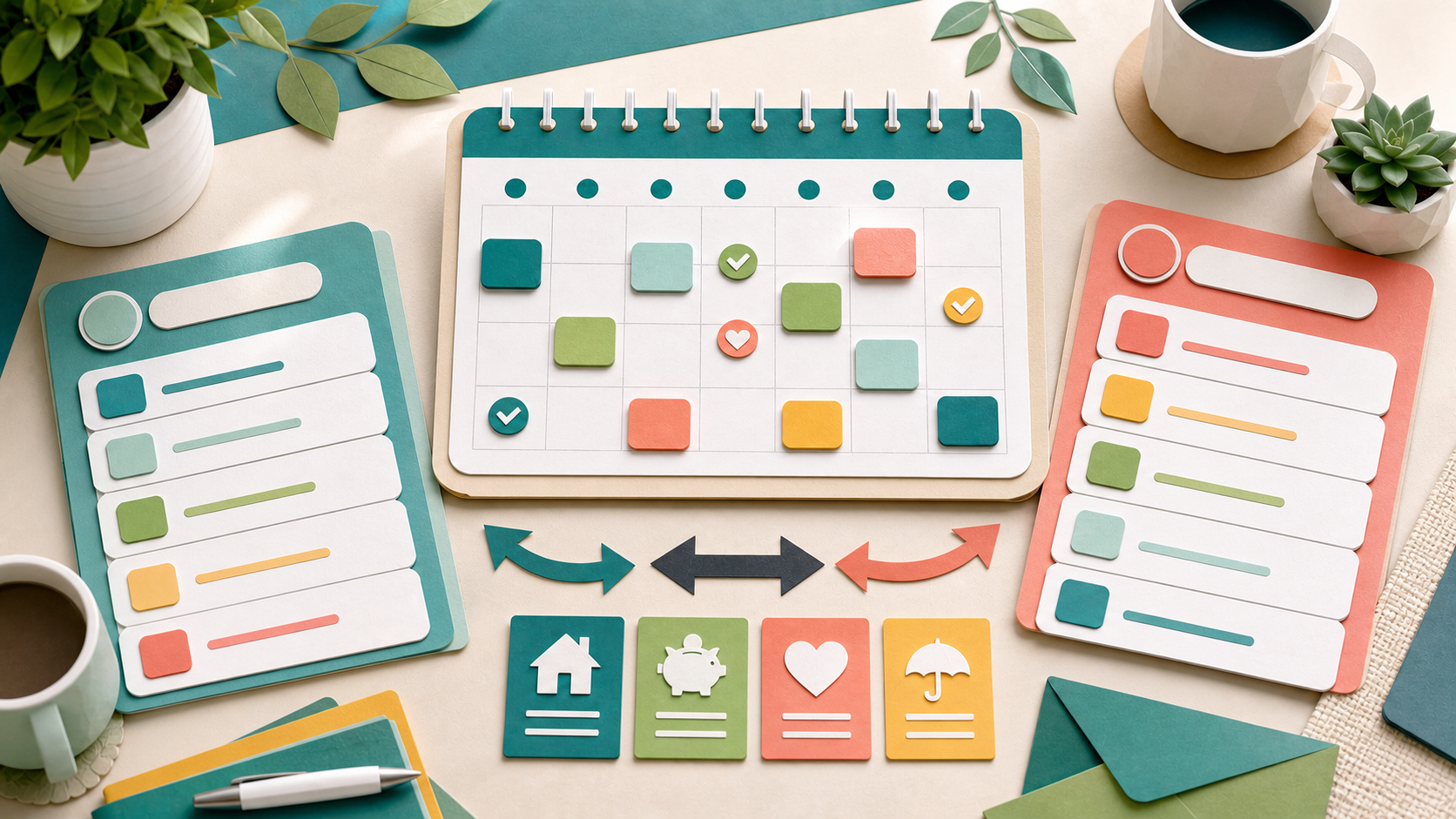
A money date does not have to be a heavy household meeting. For many couples and families it is simply a short monthly check-in that prevents small surprises from becoming stressful. The point is not to judge every receipt. The point is to make income, bills, groceries, subscriptions, school costs and savings decisions visible before the month starts moving.
A good money date is not a debate about who is right. It is a recurring moment to look at the next month together. What income is expected? Which payments are fixed? Which amounts are already reserved? Which decisions need to be made now so they do not turn into pressure later?
Nibud, the Dutch household finance institute, recommends putting income and expenses in order and using a cashbook, household book or app to keep insight. Wijzer in geldzaken stresses clear financial agreements for people who live together or marry. A money date turns that guidance into a routine: you do not only record numbers, you decide what the household will do with them.
FlowyZ fits this routine because a money date is mostly about timing. Today's balance says little if rent is due tomorrow, childcare next week and an annual bill later in the month. In FlowyZ the month becomes a timeline, so the conversation can move from searching for numbers to making choices.
Money date: choose one fixed moment
A money date works best when it has a fixed place in the month. Choose the first Sunday after salary, the last Thursday of the month or an evening after both incomes have arrived. The exact moment matters less than the repetition.
Without a fixed moment, the conversation tends to slip. Then money is discussed only when something feels wrong: an account is lower than expected, a bill surprises someone or a transfer was forgotten. That makes money emotional immediately. A fixed money date lowers the temperature because the conversation becomes part of household maintenance.
Keep it short. Thirty minutes is often enough. Put it in the calendar, use the same order every time and stop on time. If a large topic appears, schedule a separate conversation. The monthly money date is meant to steer the month, not solve every financial question in one sitting.
For couples and shared households, it helps to keep the start neutral. Begin with the plan, not with mistakes. Which payments are coming? Which costs are new? Which money is truly free? Those questions are better than opening with blame.
Start with known money dates
The first step is simple: list the known money dates. Include salary, benefits, rent or mortgage, energy, insurance, childcare, internet, phone, subscriptions, loans, sports fees, school costs, healthcare costs and fixed savings transfers.
Many households know these costs roughly, but not always in the same sequence. That sequence matters. A monthly total can be fine while the first week still feels tight. Or the month can seem comfortable until three direct debits arrive close together.
Nibud's planning and budgeting guidance is about gaining grip on money. That is not only about how much you spend. It is also about seeing ahead. A money date translates that into a month: which dates do we need to know before we treat any balance as available?
In FlowyZ, these fixed money dates can be visible every month. You do not need to rebuild the list from memory. You can see planned payments, expected income and moments where the margin becomes thinner.
Use a short agenda
A money date can go off track if everything is discussed at once. Use a fixed agenda. It can be simple:
- what changed since the last money date;
- which income arrives this month;
- which fixed costs and annual bills are coming;
- which variable costs need attention;
- which reserves or goals receive money;
- which decision are we making today;
- who takes which action before the next check-in.
This agenda makes the conversation practical without making it cold. You do not have to improvise. If the conversation drifts into an old irritation, return to the agenda item.
Make every decision concrete. Not: we should spend less. Better: this month groceries stay around 650 euro, subscription X is paused, 150 euro goes to school costs and the dental bill is placed in the timeline. A decision without an amount, date or owner disappears quickly.
FlowyZ helps because the agenda can connect to the timeline. You are not only looking at categories. You are asking whether the month can carry the decision.
Agree limits for small choices
A monthly meeting should not mean every small purchase needs permission. That becomes tiring and often unfair. Agree limits instead. Up to what amount can each person decide alone? From what amount do you discuss it? Which costs are shared decisions and which remain personal?
Examples:
- personal spending below 50 euro stays personal;
- shared purchases above 100 euro go on the agenda;
- unexpected costs above 250 euro are discussed the same day;
- a new subscription is added only if something else is cancelled;
- money in a reserve is used only for that reserve's purpose.
Rules like these prevent tiny arguments. Nobody has to ask whether a lunch, book or sports item is allowed if it fits personal room. At the same time, large choices cannot quietly change the month.
This article is not about how to split shared costs. For that, read shared money household. The money date is about rhythm, decisions and limits, so existing agreements keep working.
Put variable costs on the table
Groceries, fuel, clothes, gifts, outings and small household purchases are often the categories that make a month feel unstable. Not because they are secret, but because they move. A money date should therefore cover more than fixed bills.
Look at the next four weeks. Are there birthdays? School payments? A car appointment? Holiday preparation? Extra healthcare costs? Dinner plans? When these are named in advance, they feel less like someone broke the plan later.
Wijzer in geldzaken advises people who live together to make clear agreements about property, debts, housing and other money topics. Ongoing households can use the same principle in a smaller monthly form: be clear about which variable costs you already see coming.
In FlowyZ, known variable costs can be added as soon as they appear. The estimate does not need to be perfect. A reasonable estimate is better than a forgotten cost. If reality differs, discuss that in the next money date.
Decide what is not free to spend
One of the most useful sentences in a money date is: this money already has a job. Money in the account can look available while it is really needed for rent, taxes, holiday, health deductible, annual insurance or a replacement appliance.
At the end of the meeting, try to know three numbers:
- money needed for upcoming payments;
- money that stays reserved for known goals;
- money that is truly free for choices.
The third number is often lower than the bank balance. That is not bad news. It is clarity. A household is less likely to be surprised when money with a job is not accidentally spent.
Read annual bills planning and sinking funds planning if many surprises are actually known future costs. The money date is where you check whether those reserves are still receiving attention.
Write decisions down briefly
A money date without a decision log can become repetitive. You think something was agreed, but a month later nobody remembers the amount, date or action. Keep a short list.
Record only what changes something. For example:
- from July, the shared account contribution rises by 75 euro;
- the streaming subscription is paused for three months;
- school costs receive a 120 euro reserve this month;
- a garage quote above 600 euro will be compared first;
- the buffer may not drop below 500 euro without discussion.
That is enough. You do not need minutes. A short decision log prevents the same conversation from restarting. It also shows when agreements have become outdated.
FlowyZ is useful because amounts and timing sit next to each other. A decision is not just text. You can see what it does to the coming weeks.
Use the money date when tension appears
Sometimes there is tension. One person feels controlled. The other feels alone with the responsibility. Or both feel that the other person does not see the month clearly. A money date will not solve that automatically, but it gives structure.
Keep the conversation more factual in those moments. Start with upcoming payments. Name the shared limits. Discuss one decision at a time. Do not bring an old list of accusations. If emotions run high, make the agenda smaller: only the next two weeks and only the necessary actions.
A good rule: discuss behaviour as a pattern, not as a character flaw. Not: you are irresponsible. Better: the loose grocery spending has been above plan for three months, so we need to adjust either the amount or the routine.
If the money problem is bigger than a household planning conversation, seek help early. Nibud and Wijzer in geldzaken provide accessible information about getting money matters in order. With debts or payment arrears, early contact with the municipality, creditors or suitable help is usually better than waiting.
A simple monthly rhythm
Make the money date part of a monthly rhythm. At the start of the month, place fixed costs and known one-off costs. Halfway through, do a short check. At the end, review what was different from the plan.
Use three steps:
1. Look ahead: which income, fixed bills and known costs are coming? 2. Adjust: which variable costs are higher or lower than expected? 3. Learn: which payment should be planned earlier next month?
After a few months, the money date usually becomes shorter. Not because less happens, but because the language becomes familiar. You know what fixed bills are, what reserves are, what personal room means and which decisions actually matter.
FlowyZ makes this rhythm practical. The month is no longer spread across banking apps, memories and loose notes. Money dates become visible in time. That makes the money date less about searching and more about choosing.